ShelfCastAI · Post-Harvest Intelligence
ShelfCastAI predicts the remaining shelf life of every harvested batch and routes it to the buyer most likely to use it before quality declines.
Built for controlled-environment agriculture, using the harvest and cold-chain data you already collect.
Software-first · Hardware-agnostic · Works with existing harvest and temperature data
01 · THE BRAIN
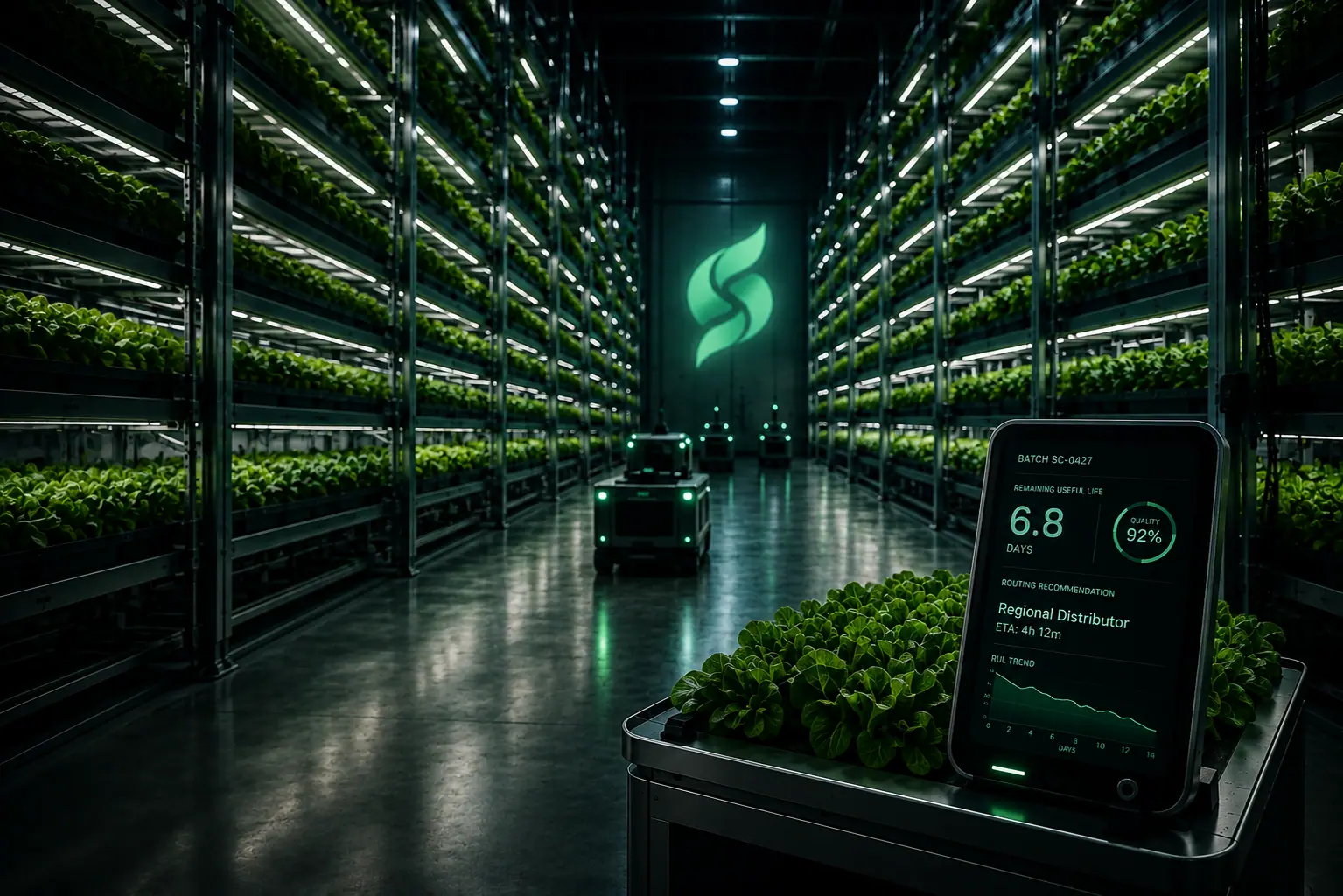
The moment produce is harvested, its clock starts. Temperature, variety, handling — ShelfCastAI reads those variables and estimates how much usable life remains in each batch.
LIVE PREDICTION
02 · THE DRIVER
A restaurant that turns greens in 2 days needs a different batch than a distributor who holds for 5. ShelfCastAI matches each batch's estimated remaining life to each buyer's consumption speed — before the truck leaves the dock.
03 · THE DECIDER
In modeled mid-sized operations, better batch-level routing represents hundreds of thousands of dollars a year in recoverable value. ShelfCastAI makes the routing call on every batch, every day — by shelf life, not just distance or volume.
$300K+
modeled recoverable value · mid-size operation · USDA loss benchmarks
04 · THE ARRIVAL
The batch that would have sat too long at one account instead reaches a kitchen that's ready for it — served fresh, the same week it was cut.
harvest → prediction → routing → table
The industry problem
A batch with three usable days remaining should not follow the same distribution strategy as a batch with ten. Yet most routing systems don't have a reliable batch-level shelf-life signal when that decision is made — inventory is dispatched by demand, destination, or FIFO without accounting for how differently each batch will deteriorate.
Most produce operations still make routing decisions without batch-level Remaining Useful Life intelligence. ShelfCastAI adds it.
How it works
ShelfCastAI sits between harvest and destination. It reads the data your operation already produces, estimates how much usable life each batch has left, and matches that batch to a channel that fits.
Use data already generated by your operation.
Estimate Remaining Useful Life at the batch level.
ShelfCast combines each batch's conditions with its shelf-life intelligence to estimate how long that inventory stays commercially usable. Outputs include estimated Remaining Useful Life, a risk score, and a predicted quality window.
Try the shelf-life calculator →Match the batch to a destination that fits its remaining life.
Shorter-life inventory moves toward nearby or high-velocity buyers. Longer-life inventory can support longer transit times and slower retail channels.
Batch-level routing
Three batches leave the same harvest with very different usable lives. ShelfCast estimates that difference before the routing decision is made.
Batch A
illustrative
Baby spinach · 4°C hold
Recommended route
Local high-volume kitchen
Transit: 22 min
Batch B
illustrative
Butterhead lettuce · 2°C hold
Recommended route
Regional distributor
Transit: 4 hr
Batch C
illustrative
Tuscan kale · 1°C hold
Recommended route
Retail channel
Transit: 1 day
Illustrative scenario using USDA / UC Davis postharvest decay baselines. Not customer data.
Interactive demo
Change the batch conditions and see how Remaining Useful Life changes where that inventory should go.
Where we start
CEA is the wedge — high-frequency harvest environments where freshness, routing, and fulfillment decisions happen every day, and where conditions are controlled enough to make batch-level prediction reliable. Vertical farms, greenhouse operations, indoor farms, and regional produce growers are the first operators we're building with. The routing layer extends outward from there.
The routing network
Restaurants, distributors, and retailers are destinations within one routing decision — not separate products. Two of them have a purpose-built ShelfCast module you can try now.
Batches with a short remaining window move to buyers that consume produce within a day or two.
Powered by ShelfCast Kitchen TrackerBatches whose remaining life comfortably covers transit and inventory dwell time route to distributors.
See it in the Farm Routing DemoInventory with enough life for transport, stocking, merchandising, and consumer use supports slower retail channels.
Powered by ShelfCast Store AllocatorHardware-agnostic
ShelfCastAI is a software intelligence layer. It connects harvest records, cold-chain data, and operational inputs without replacing your farm management or sensing infrastructure. Farms do not need to buy proprietary sensors or swap out current systems to evaluate the platform.
Designed to integrate with harvest tracking systems, cold-chain temperature loggers, spreadsheets, and ERP/WMS exports. Integrations are added alongside design partners rather than assumed to be production-ready today.
Validation
A farm doesn't have to hand routing to an unvalidated system. ShelfCast begins as decision support — showing what it would recommend and why — while it's validated against real outcomes. Automation comes later.
Harvest logs, temperature records, and shipment outcomes — a spreadsheet is enough to start.
We estimate Remaining Useful Life across your previous harvests using their recorded conditions.
See where alternate routing may have preserved more usable inventory than the decision that was made.
Move into real-time routing recommendations once the model is calibrated against your outcomes.
Intelligence before automation.
ShelfCast shows operators what it would recommend and why. Teams stay in control of routing decisions while the system is validated against real-world outcomes.
Category
Inventory systems
Tell you what exists.
Quality inspection systems
Tell you what condition it's in.
 ShelfCastAI
Helps decide where that batch should go next.
harvest
↓
quality / inventory systems
↓
ShelfCastAI — shelf-life prediction + routing intelligence
↓
distributor / restaurant / retail
Built by an operator
At 80 Acres Farms, a controlled-environment agriculture operator, I worked on the systems that estimated how long produce would last and how much was lost during packaging. I saw how routing and fulfillment decisions were actually made around fresh inventory — and how rarely shelf life was a real input.
At Intel, I'm a Tech Lead and System Optimization Software Engineer building operational intelligence for 24/7 manufacturing — equipment performance, shift handoffs, and production bottlenecks.
ShelfCastAI is the intersection: firsthand post-harvest experience and production-grade engineering, aimed at one unsolved operational problem — where each batch should go, given how much time it has left.
Design partners
We're working with a small group of CEA operators to validate ShelfCast against real harvest, temperature, routing, and quality outcomes.
What a design partner gets
What we can start with
Even a historical dataset can help us validate ShelfCast. Useful inputs:
Modeled example
In one modeled mid-sized operation, improved batch-level routing represented more than $300K in potentially recoverable annual value. This is a modeled scenario built on USDA post-harvest loss benchmarks — not a measured customer result.
Become a Design Partner
A few fields to see if it's a fit. We reply personally.
Prefer to talk first? Talk to the founder →
FAQ
ShelfCastAI predicts the Remaining Useful Life of harvested inventory and helps operators determine which destination best fits each batch’s usable life. It sits between harvest and destination as an intelligence layer.
Initially, controlled-environment agriculture operators — vertical farms, greenhouses, indoor farms — and other high-frequency produce operations. Restaurants, distributors, and retailers are destinations within the routing network.
No. ShelfCastAI is designed to work with existing operational and cold-chain data rather than requiring proprietary ShelfCast hardware. If you already log harvest timestamps and storage temperatures, that is enough to start.
Typical inputs include crop type, harvest timestamp, temperature history, shipment information, and quality outcomes where available. Not every field is mandatory — more history makes predictions sharper.
During validation, ShelfCast operates as decision support. Operators review each recommendation and the reasoning behind it, and stay in control of routing. Automation is a later step, once the model is calibrated to your operation.
Accuracy depends on the crop, available data, storage conditions, and validation history. The baseline model uses USDA Handbook 66 and UC Davis postharvest research; predictions are calibrated and evaluated against your actual outcomes rather than claiming universal accuracy.
Yes. Historical harvest and shipment data can be used to evaluate ShelfCast’s predictions and routing recommendations before any live deployment. A spreadsheet of past harvests is a valid starting point.
ShelfCastAI helps you make the routing decision before time makes it for you.